

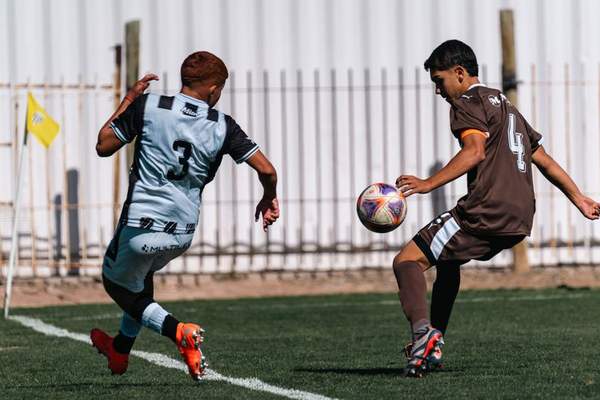
The 4-3-3 soccer formation looks straightforward on a team sheet: four defenders, three midfielders and three forwards. On the field, though, its success depends less on those numbers than on the distances between players. A winger holding the touchline can open a central passing lane; a midfielder arriving a second late can leave the full-back exposed. Understanding those relationships makes the 4-3-3 useful for players, coaches and anyone trying to read a match.
How the 4-3-3 Is Arranged
The goalkeeper sits behind a back four of two center-backs and two full-backs. Ahead of them is a three-man midfield, usually with one deeper holding player and two more advanced central midfielders. The front line features a left winger, a center forward and a right winger. The numbers describe the starting arrangement of the ten outfield players, not positions they must occupy throughout a game.
A common variation is called a 4-1-2-3: the holding midfielder, or number six, plays behind two number eights. Some teams instead use two deeper midfielders and a more advanced creator. Both approaches can be described as a 4-3-3, but their defensive cover and passing options differ.
Player Roles: What Each Line Contributes
Defenders and Goalkeeper
Center-backs protect the area in front of goal and initiate attacks with passes into midfield or toward the flanks. Full-backs defend opposing wide players but may also overlap a winger or move inside to support possession. The goalkeeper offers an additional passing option during buildup. When one full-back advances, someone must protect the space behind that player.
The Midfield Three
The holding midfielder connects defense and attack, receives under pressure and screens passes toward the center-backs. The two number eights create passing angles, support wide combinations and make runs beyond the forwards when space appears. They also have to recover quickly when possession changes. A strong midfield unit works at different heights rather than standing in a flat horizontal line.
The Front Three
The center forward occupies central defenders, attacks crosses and provides a target for combinations. Wingers can stay wide to challenge full-backs one-on-one or move inside toward goal. When a winger cuts in, an overlapping full-back may supply width instead. These movements need timing: if everyone moves into the same channel, the attack becomes crowded.
How a 4-3-3 Builds and Creates Chances
One attraction of 4-3-3 tactics is the number of natural passing triangles. On the right, for example, the right center-back, holding midfielder and right-back can circulate the ball before finding the right winger or right-sided eight. Triangles give the player in possession more than one realistic passing route.
A wide attacking shape stretches the defending team horizontally. If the opposition shifts toward one winger, a switch of play may free the opposite flank. If defenders stay wide, a midfielder can exploit a gap inside. The center forward can drop short to link play, but a winger or midfielder should then threaten the space behind the defense.
Good attacks also need protection against a turnover. Coaches call this rest defense: positioning players behind or near the ball to slow a counterattack. Sending both full-backs forward without adequate midfield cover may create chances, but it can also leave the center-backs facing dangerous open-field situations.
Pressing and Defending Without the Ball
The front three give the 4-3-3 a natural starting point for pressing. A striker might approach a center-back while blocking the pass into the opponent’s holding midfielder. The near-side winger then presses the receiving full-back, with a number eight stepping up behind. The aim is not simply to run harder; it is to remove easy passes together.
If the first press is beaten, the midfield must shift across and protect the area between the lines. A winger may drop alongside the two advanced midfielders, producing a 4-1-4-1 defensive block. This is normal: formations change shape between attacking and defending phases.
The hardest moment is often the first few seconds after losing the ball. The nearest players can press immediately if they have support, or retreat into a compact shape when pressing would leave large gaps. Recognizing which response is safer matters more than insisting on constant high pressure.
Where the Formation Is Strong—and Vulnerable
The 4-3-3 offers three clear strengths. First, its midfield can outnumber opponents who use only two central midfielders. Second, wingers create width while the number eights connect attacks through inside channels. Third, three forwards can close passing routes across an opponent’s defensive line. These advantages explain why the setup works for both possession-based and direct attacking teams.
Its weaknesses are just as specific. An advanced full-back can be attacked in the space left behind. A single holding midfielder may be stretched when opponents move the ball quickly from side to side. The lone striker can become isolated against two center-backs if the wingers and eights offer little support. Against a midfield diamond, the central three may even be outnumbered.
A Practical 4-3-3 Coaching Example
Picture a youth team attacking down its left. The left winger receives wide, drawing the opposing right-back toward the sideline. The left-sided eight moves into the inside channel and the left-back starts an overlapping run. The winger now has three choices: drive at the defender, slip a pass inside or release the overlap.
Practice this as a three-versus-two exercise along one flank, then add a holding midfielder behind the attack. When possession is lost, ask the players to identify who presses the ball and who protects the central lane. This teaches an attacking combination and its defensive consequence in the same repetition.
Newer coaches may also find it helpful to study pressing triggers in soccer, the role of a defensive midfielder and the 4-4-2 formation alongside this soccer formation guide. Those related concepts explain why a shape that looks balanced on paper can become vulnerable during transitions.
Frequently Asked Questions
Is the 4-3-3 an attacking formation?
It can be, particularly when the wingers and full-backs advance. But the same team can defend compactly in a 4-1-4-1 shape. Player responsibilities and pressing choices determine its character.
What is the difference between a 4-3-3 and a 4-2-3-1?
A typical 4-3-3 uses three central midfielders, often one holding player and two eights. A 4-2-3-1 normally has two deeper midfielders supporting an attacking midfielder behind the striker. Teams can shift between the two shapes during play.
Does the 4-3-3 require fast wingers?
Pace helps when attacking space behind defenders, but it is not essential. Wingers with good first touches, positioning and decision-making can create chances through combinations and changes of direction.
What is the biggest coaching priority in a 4-3-3?
Start with spacing and coordinated movement. Players should know who provides width, who supports underneath the ball and who stays positioned to stop a counterattack. Add complex pressing patterns once those habits are reliable.
Final Thoughts
The best 4-3-3 teams do not simply place three players up front. They connect the defensive line, midfield and forwards through purposeful movement. When width, central support and defensive cover work together, the formation gives a team multiple ways to build, press and attack without losing its balance.