

Youth soccer has a rhythm all its own. One minute a player is jogging into space, the next they are sprinting after a loose ball, turning sharply, stopping suddenly, or jumping into a challenge. It is not the kind of sport where fitness means simply running long distances. Soccer fitness is layered. It asks for speed, balance, endurance, coordination, quick recovery, and the ability to stay mentally sharp when the legs start to feel heavy.
That is why youth soccer conditioning drills matter so much. They help young players build the kind of fitness that actually shows up on the field. Good conditioning is not about exhausting kids until they dread practice. It is about preparing their bodies for the stop-start nature of the game while keeping sessions energetic, purposeful, and age-appropriate.
When conditioning is done well, players do not just run more. They move better. They react faster. They stay confident deeper into a match. And, just as importantly, they learn how to enjoy the physical side of soccer rather than seeing fitness work as punishment.
Why Conditioning Looks Different in Youth Soccer
Young soccer players are still developing physically, technically, and emotionally. Their training should reflect that. A conditioning session for a fourteen-year-old team should not look like a scaled-down version of a professional preseason workout. Younger athletes need variety, recovery, and drills that connect fitness to the game itself.
The best youth soccer conditioning drills usually include the ball, decision-making, or competitive movement. Players are more engaged when they understand why they are running, changing direction, or repeating short bursts of effort. A drill that asks players to sprint, receive a pass, turn, and finish feels like soccer. A drill that asks them to run laps for twenty minutes often feels disconnected.
There is also a safety element. Overloading young athletes with too much repetitive running can increase fatigue and poor movement habits. Conditioning should build capacity gradually. Coaches and parents should pay attention to posture, breathing, coordination, and signs of overtraining. A tired player can still learn, but an exhausted player usually cannot.
Building Endurance Without Boring the Team
Endurance in soccer is not just about lasting the full match. It is about recovering quickly between efforts. A player may sprint ten yards, jog five, press an opponent, then drop back into shape. This cycle happens again and again. So, conditioning should train that pattern.
Small-sided games are one of the most natural ways to build soccer endurance. A four-versus-four or five-versus-five game on a reduced field forces players to move constantly. There is less standing around, more touches, and more repeated transitions from attack to defense. Players build aerobic fitness without feeling like they are doing traditional running.
Another useful approach is tempo passing. Players work in groups, passing and moving through a simple pattern for several minutes at a steady pace. The focus stays on clean touches and constant movement. After a short rest, they repeat the sequence. Over time, this improves stamina while reinforcing technical habits.
For younger players, coaches can turn endurance work into challenges. For example, a team might try to complete a certain number of passes while every player must move into a new space after passing. The drill keeps the body moving and the mind active. That combination is far more useful than plain jogging.
Speed Drills That Match the Game
Soccer speed is rarely a straight forty-yard sprint. It is usually a five-yard burst, a sharp turn, or a sudden race to the ball. Young players need to practice acceleration from different body positions and directions.
A simple chase drill works well. One player starts with the ball, while another begins a step or two behind. On the coach’s signal, the first player dribbles toward a gate, and the second tries to catch up. This creates realistic pressure and teaches the attacker to accelerate while controlling the ball. The defender learns pursuit speed and timing.
Another effective drill is the reaction sprint. Players stand facing the coach, who points left, right, forward, or backward. The players react and sprint a short distance in that direction. To make it more soccer-specific, the coach can add a ball after the first movement, asking players to sprint, receive, and pass. This trains both quick thinking and explosive movement.
Speed work should be short and sharp. If every sprint becomes slow because players are too tired, the drill is no longer training speed. Rest matters. Young players need enough recovery to perform each repetition with quality.
Agility and Change of Direction
Soccer is full of awkward angles. Players cut inside, recover defensively, spin away from pressure, and adjust their feet before receiving a pass. Agility training helps them move with more control and less wasted energy.
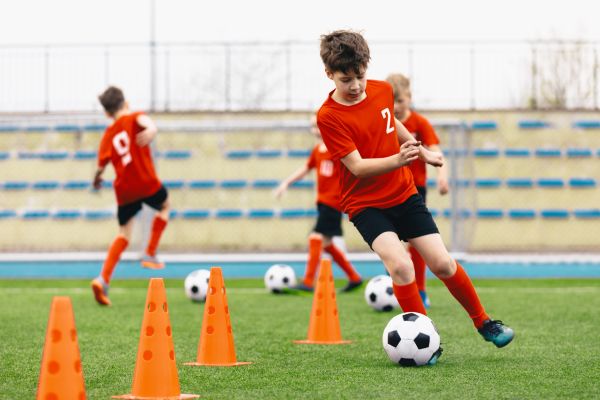
Cone patterns can be useful, but they should not become robotic. A basic zigzag run through cones teaches footwork, yet the drill becomes better when a player has to make a choice. For instance, after weaving through cones, the player receives a pass and must decide whether to turn left or right based on a defender’s position.
Mirror drills are also excellent for youth players. Two players face each other in a small grid. One leads, moving side to side, forward, and backward, while the other mirrors the movement. After ten to fifteen seconds, they switch roles. This builds quick feet, balance, and defensive body control. It also feels like a game within a game, which keeps energy high.
Ladder drills can support coordination, especially for younger athletes, but they should not be treated as magic. Fast feet on a ladder only matter if the player can transfer that movement onto the field. Pairing ladder work with a pass, turn, or short sprint makes it more valuable.
Strength Through Bodyweight Movement
Strength is often overlooked in youth soccer conditioning, but it plays a quiet role in almost everything. Stronger players can hold balance under pressure, change direction more safely, and repeat movements without breaking down. For younger players, bodyweight exercises are usually enough.
Squats help build leg strength and teach players how to bend properly. Lunges support single-leg balance, which is important because soccer is full of one-footed actions. Planks build core control, helping players stay stable when shielding the ball or striking it. Glute bridges, side planks, and controlled jumping movements can also be added in small amounts.
The key is technique. A rushed set of sloppy exercises does not help much. Coaches should keep strength blocks short and focused. Five to eight minutes of clean bodyweight work can be more useful than a long session where players lose form.
Strength work can also be blended into stations. One station might include squats, another short dribbling bursts, another passing under pressure, and another balance work. Players rotate through, staying active without doing the same movement for too long.
Ball-Based Conditioning Drills
The most enjoyable youth soccer conditioning drills usually involve the ball. Players forget they are doing fitness work because they are focused on scoring, passing, or beating an opponent.
A dribble-and-recover drill is simple but effective. Players dribble quickly to a cone, turn, and return to the start before passing to the next teammate. The repeated acceleration and change of direction build conditioning while improving ball control.
Another strong option is continuous two-versus-one. Two attackers try to beat one defender and score in a small goal. As soon as the play ends, a new ball enters, and players rotate quickly. The drill demands sprinting, decision-making, and recovery. It also teaches attackers to move with purpose instead of simply running into pressure.
Rondo variations can condition players too. In a tight grid, players keep possession while defenders press. The intensity rises naturally because defenders must work hard to win the ball, and attackers must constantly adjust their position. Short rounds with quick rest periods are ideal.
Recovery Is Part of Fitness
Young players often think conditioning means pushing harder every time. But recovery is part of becoming fit. Muscles adapt during rest. The nervous system needs breaks. Even confidence improves when players feel fresh enough to perform well.
Coaches should include water breaks, breathing resets, and light mobility between intense drills. Players can walk, stretch gently, or juggle at a relaxed pace. These small pauses keep the session productive and reduce the risk of sloppy movement.
Sleep, hydration, and food matter too. A player who skips meals or stays up late will struggle no matter how good the training plan is. Youth soccer fitness is not built in one dramatic workout. It is built through steady habits, consistent practice, and enough rest to come back ready.
Keeping Conditioning Fun and Competitive
The emotional side of youth training matters. If conditioning feels like punishment, players may start to associate fitness with failure. A better approach is to make drills competitive, playful, and connected to soccer goals.
Timed team challenges can work well. Players might try to complete a passing circuit within a set time while keeping good technique. Small races with the ball can create excitement. Finishing drills after a sprint add motivation because there is a clear reward at the end.
Competition should be healthy, though. The aim is not to embarrass slower players. It is to encourage effort, improvement, and teamwork. Coaches can celebrate personal progress just as much as winning a race.
Conditioning for Different Ages
Younger players need movement variety more than structured fitness blocks. Their conditioning can come through tag games, dribbling races, small-sided matches, and coordination activities. The goal is to build athletic foundations without making training feel rigid.
Pre-teens can handle slightly more structure. They can learn proper sprint mechanics, basic bodyweight strength, and short interval drills. Still, the ball should remain central. At this age, players are developing habits that may stay with them for years.
Teen players can take on more demanding conditioning, especially as match intensity increases. They may benefit from planned intervals, strength circuits, and position-specific work. Even then, balance is important. Too much fitness work at the expense of technical training can leave players tired but not necessarily better.
A Smarter Way to Build Peak Fitness
Peak fitness in youth soccer is not about who can run until they collapse. It is about who can move well, recover quickly, stay composed, and keep making smart plays late in the game. The best youth soccer conditioning drills respect the rhythm of the sport and the age of the athletes.
Conditioning should feel like preparation, not punishment. It should include speed, agility, endurance, strength, and recovery, all tied together with the ball whenever possible. When young players train this way, they become more than fitter athletes. They become more confident soccer players.
In the end, the goal is simple. Help players enjoy the work, understand their bodies, and feel ready for the demands of the game. Fitness built with patience lasts longer. And on the soccer field, that steady foundation can make all the difference when the match gets fast, loud, and beautifully unpredictable.