

Soccer allows plenty of physical contact, but there is a clear line between a fair challenge and an offence. Under the current IFAB Laws of the Game, familiar fouls include tripping, pushing, kicking, charging, striking, and tackling an opponent when the referee considers the action careless, reckless, or made with excessive force. Other offences, including handball and holding, can also produce a direct free kick.
Not every collision is a foul, and not every offence produces the same restart or disciplinary punishment. The referee considers what happened, how it happened, where it happened, and the level of danger involved.
The Main Direct Free Kick Fouls
The core soccer foul list begins with seven actions against an opponent: charging, jumping at an opponent, kicking or attempting to kick, pushing, striking or attempting to strike, tackling or challenging, and tripping or attempting to trip. They become offences when performed carelessly, recklessly, or with excessive force.
Careless means a player has shown insufficient attention or precaution; a direct free kick is normally enough. Reckless means the player has disregarded the danger or consequences to an opponent and must be cautioned. Excessive force means the action goes beyond what is necessary or endangers an opponent’s safety and can lead to a red card.
Tripping and Pushing
Tripping and pushing are common examples. If a defender clips an attacker’s foot with a poorly timed challenge, the trip may be careless. A fair shoulder-to-shoulder challenge can be legal while both players compete for the ball, but a shove in the back or an extended arm that knocks an opponent off balance is much more likely to be penalised.
Kicking, Striking, Charging, and Jumping
Solid contact is not always required. Attempting to kick or strike an opponent can itself be an offence. Jumping into an opponent or charging with disregard for safety can also cross the line from normal physical play into a foul. Referees judge the action, not simply whether the opponent falls.
Tackles and Challenges
A clean tackle is legal when the player fairly plays or challenges for the ball without another offence. Winning the ball first does not automatically make every tackle legal. A follow-through can still be reckless or excessively forceful. For example, a player may touch the ball and then lunge through an opponent with exposed studs; the referee can still punish the challenge because of the danger created.
Other Direct Free Kick Offences
Law 12 also gives a direct free kick for a handball offence, holding an opponent, impeding an opponent with contact, biting or spitting, or throwing an object at the ball, an opponent, or a match official. Contacting the ball with an object held in the hand is covered too.
If a defender commits a direct free kick offence inside their own penalty area, the restart is normally a penalty kick. That is why even a relatively simple shirt pull or careless trip can have a major consequence inside the box.
How the Handball Rule Works
The handball rule is often misunderstood because accidental contact is not automatically an offence. For handball decisions, the arm begins below the bottom of the armpit. A player commits an offence by deliberately touching the ball with the hand or arm, or by touching it after making the body unnaturally bigger with an arm position that is not justified by the player’s movement in that situation.
An attacker also cannot score directly with the hand or arm, even accidentally, or score immediately after the ball has touched their own hand or arm. Referee judgment is crucial: a ball striking an arm naturally beside the body may be treated very differently from one striking an arm stretched well away from the torso.
Indirect Free Kick Offences
Some offences are punished with an indirect free kick instead. They include playing in a dangerous manner, impeding an opponent without contact, certain verbal offences, preventing a goalkeeper from releasing the ball, and using a deliberate trick to get around the restriction on passing the ball to the goalkeeper. Goalkeepers can also concede an indirect free kick for certain handling offences inside their own penalty area.
A practical example is a high boot near an opponent’s face. If the action threatens injury and causes the opponent to pull out of the challenge, but there is no contact, the referee may award an indirect free kick for dangerous play. If the raised boot actually kicks the opponent, the incident can become a direct free kick offence.
Why Similar Contact Produces Different Decisions
A referee judgment call is based on more than the amount of contact. The ball’s position, direction of movement, speed, point of contact, use of the arms, studs, and the player’s ability to challenge safely can all matter. Soccer is a contact sport, so contact alone is not proof of a foul.
Advantage can also make a foul look as though it was ignored. If the fouled team keeps possession in a promising situation, the referee may allow play to continue and deal with any necessary disciplinary action at the next stoppage.
Fouls, Yellow Cards, and Red Cards
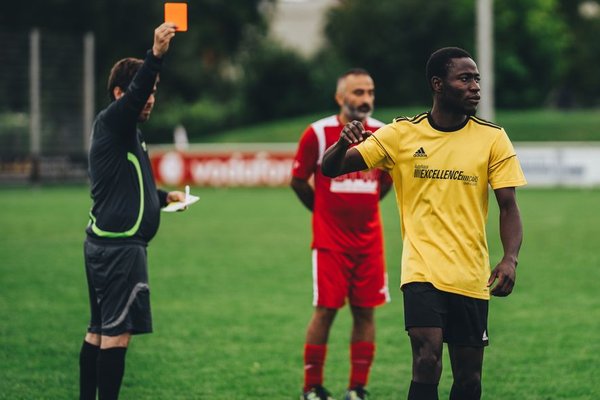
A foul does not automatically mean a card. A careless direct-free-kick offence generally needs no card. Reckless conduct requires a yellow card, while excessive-force challenges can require a red card. Cards may also be shown for misconduct that is not a typical physical foul, including dissent, delaying a restart, simulation, or offensive and abusive behaviour.
One current Law 12 detail also shows the difference between technical offences and ordinary fouls: if a goalkeeper controls the ball with the hands or arms for more than eight seconds inside the penalty area, the opposing team is awarded a corner kick. The referee visually counts down the final five seconds.
FAQ
Is every physical contact a foul in soccer?
No. Fair shoulder challenges, incidental contact, and properly executed tackles can be legal. The referee looks at whether the action was careless, reckless, or used excessive force.
Is accidental handball always a foul?
No. Not every touch of the hand or arm is an offence. Deliberate handling, an unjustifiably extended arm that makes the body unnaturally bigger, and certain hand-or-arm contacts connected to scoring are treated differently.
Can a foul happen without contact?
Yes. Attempting to kick or strike an opponent can be an offence without contact, and dangerous play can lead to an indirect free kick when an action threatens injury and prevents an opponent from safely playing the ball.
Does winning the ball mean a tackle cannot be a foul?
No. A player can touch the ball first and still commit a foul if the challenge or follow-through is reckless, uses excessive force, or otherwise endangers an opponent.
Knowing Where the Line Is
The simplest way to understand what counts as a foul in soccer is to separate fair competition for the ball from actions that are careless, reckless, excessively forceful, or specifically prohibited by Law 12. Tripping and pushing, kicking, striking, dangerous tackles, holding, and handball cover many common decisions, but the referee must still apply the Law to the exact movement and level of risk in each incident.