

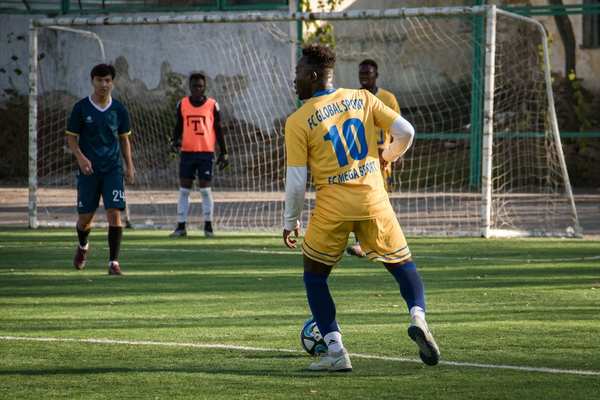
A winger loses the ball trying to beat a defender. For a moment, the opposition have possession, but not necessarily control. Their ball carrier may face the touchline, teammates may still be moving forward, and passing lanes may be crowded. Gegenpressing in soccer exploits precisely that moment.
Rather than retreating automatically, the team that lost possession presses immediately to win it back or prevent a clean counterattack. The key is not simply running harder. It is recognizing vulnerability, surrounding the ball intelligently, and keeping protection behind the press.
Why the first seconds after losing the ball matter
Gegenpressing, also called counter-pressing, is a defensive transition strategy: when possession changes, nearby players switch from attacking to defending. Traditional recovery prioritizes getting back into a settled shape. A counter-press tries to disrupt the opponent before that becomes necessary.
The opponent has just won the ball, so their first touch, body position, and passing options may be imperfect. Pressure can force a rushed clearance, backward pass, or turnover. Winning possession high upfield can also create an immediate chance against a team that has not reorganized.
There is no universal five-second rule that guarantees success. Coaches sometimes set short targets in training, but the real question is whether pressing after possession loss still offers an advantage.
How a coordinated counter-press works
The nearest player delays the escape
The first defender pressures the ball carrier quickly, ideally approaching from an angle that blocks a dangerous forward pass. Winning a tackle is useful, but slowing the opponent or forcing play toward the sideline may be enough. An uncontrolled sprint that permits a pass through midfield defeats the purpose.
Supporting players close the next passes
The second and third defenders are just as important. One closes a short option; another protects the central lane or anticipates a loose touch. Deeper players squeeze space without abandoning runners behind them. Effective counter pressing soccer teams compress the area around a turnover rather than sending everyone at the ball.
Communication helps: one player calls the press, another identifies an inside pass, and a deeper teammate signals when to recover. These decisions must happen while the opponent is trying to escape.
Pressing traps: guiding the opponent toward trouble
Some counter-presses appear to leave a pass available. In reality, the defending team wants it played. Pressing traps use a touchline, awkward body angle, or predictable receiver to make the next action easier to defend.
Imagine possession is lost near the right touchline. The nearest attacker curves their run to discourage a pass into midfield. A teammate shadows the supporting fullback, while another midfielder closes the likely inside receiver. The ball carrier is encouraged down the line, where the sideline removes an escape route. The trap works only if those movements are coordinated.
It fails when the central lane opens or the opponent can switch play freely. Good counter-pressing controls options rather than merely gathering players around the ball.
Rest defense makes aggressive pressing possible
Successful gegenpressing begins before the turnover. Rest defense describes how a team positions players behind and around an attack to control counters if it loses possession. A holding midfielder protecting the center, defenders maintaining useful distances, and a connected fullback can provide this balance.
If both fullbacks push high and the holding midfielder enters the penalty area, a lost cross may leave two center backs against several runners. Immediate pressure cannot reliably repair that gap. With better rest defense, the team has cover for a direct pass, a second-ball contest, and a retreat.
This is why a guide to rest defense in soccer belongs alongside counter-pressing: the attacking structure shapes how safely the team reacts to a loss.
A game scenario: a failed pass outside the box
Picture a team circulating the ball around the penalty area. Its attacking midfielder passes toward the striker, but a defender intercepts. The defender receives facing their own goal, with a winger wide and a midfielder offering a central outlet.
The striker closes from the defender’s outside shoulder, discouraging the wide pass. The attacking midfielder tracks the central outlet. A nearby winger narrows the gap, while the holding midfielder stays ready to intercept a longer escape pass. The back line advances carefully, prepared if the first wave is beaten.
The defender may rush a pass that gets intercepted, restarting the attack near goal. Or they may turn successfully and launch a counter. In that case, chasing recklessly makes things worse. The pressing team must recognize the failed trap and recover.
When counter-pressing becomes a liability
Retreating is sometimes smarter. If teammates are spread out, the ball carrier can face forward, or runners have moved beyond the ball, an aggressive press may open a route to goal.
Watch for three warning signs: the nearest defender cannot affect the ball quickly; an opponent has a clear forward passing lane; or deeper cover is outnumbered. When these appear, players should slow the attack, protect central spaces, and rebuild a compact shape.
Technically secure opponents can use third-player passes or switches to bypass pressure. The principles of high pressing in soccer offer a useful comparison: pressure against settled possession is different from reacting to a fresh turnover.
How coaches can train the transition
A small-sided possession game is a practical starting point. Use a compact playing area with two teams and neutral players. When a team loses possession, award an extra point if it wins the ball back promptly; reward its opponent for passing successfully into an exit zone. This trains both the press and the escape.
Pause at turnovers. Ask who pressures the ball, who guards the central pass, and who provides deeper cover. Restart the situation. Value a forced backward pass and safe recovery as well as a spectacular tackle.
Players learning about defensive transitions in soccer should also study what happens when the press is beaten. Stopping at the right time is part of the skill.
Frequently asked questions
Is gegenpressing the same as high pressing?
No. Gegenpressing occurs immediately after losing possession, wherever the turnover happens. High pressing describes organized pressure against a team already in possession, usually in advanced areas. Both strategies can work together.
Does every player rush toward the ball?
No. Nearby players pressure and block short options, while others protect central lanes, track runners, and maintain balance. If everyone chases the ball, one pass can bypass the group.
Can a team use gegenpressing without a high defensive line?
Yes. Counter-pressing is a transition behavior, not a fixed formation or defensive-line height. Teams can apply it in different areas when support and cover make it sensible.
What is the biggest risk of an unsuccessful counter-press?
It can leave open space behind or between players. When the opponent escapes, they may counterattack against a stretched team before its defenders recover.
Conclusion
The defining feature of gegenpressing in soccer is the immediate, collective response to losing the ball. Smart pressure disrupts the first pass, nearby support creates traps, and rest defense guards against escape. Equally important is knowing when the opportunity has disappeared. The strongest counter-pressing teams do not chase every turnover; they recognize which ones they can control.