

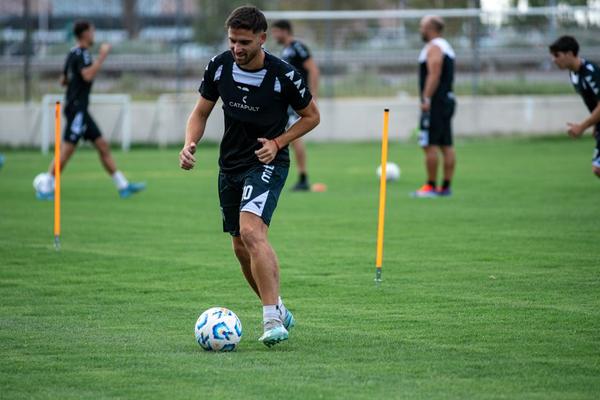
Pressing looks convincing when everyone moves at the right moment. One player sprints toward the ball, a teammate blocks the easy pass, and the rest of the group closes dangerous spaces. Without that coordination, pressure becomes exhausting individual chases. The best soccer pressing drills teach players to recognize a signal, arrive at an effective angle, and react together when possession changes.
These exercises move from simple decisions to game-like situations. They need cones, balls, bibs, and an area scaled to your players’ age and experience.
Coach three jobs, not just the first sprint
Every effective press involves pressure, cover, and balance. The nearest defender approaches the ball carrier, steering play toward a teammate or touchline. The next defender protects the pass behind that pressure. Others stay compact while watching runners and dangerous space.
Introduce a shared trigger. A heavy first touch, a slow backward pass, or a receiver facing their own goal can signal an opportunity. The trigger starts the action; supporting movements make it work. Players should slow their final steps so they can change direction rather than get beaten by one touch.
Drill 1: Two defenders react to a loose touch
Setup and action
Mark a 15-by-12-yard rectangle. Put two attackers at one end and two defenders opposite them. A coach passes to an attacker, who tries to dribble or combine across the far line. Defenders initially hold position and press when the receiver takes a deliberately loose first touch.
The closest defender closes from an angle discouraging the central pass. Their partner covers slightly behind and inside. Award defenders a point for regaining possession or forcing play outside; attackers score for crossing the line under control.
After several repetitions, remove the scripted bad touch. Defenders must decide whether the actual reception warrants pressure. This turns a rehearsed pattern into one of the simplest pressing trigger drills.
Drill 2: Three-player pressing triangle
Setup and action
Use a 20-by-18-yard area with three attackers against three defenders and a small target gate at each end. Attackers score by passing or dribbling through either gate; defenders score by winning the ball and passing to their coach.
As the first defender presses, a second protects the nearest forward pass while a third balances on the far side. Pause occasionally and ask: if the ball moves one pass away, who presses next? Players should rotate jobs as the ball travels rather than follow fixed opponents.
These team pressing exercises show whether teammates move on the same cue. If one pass repeatedly splits the group, shorten the area or briefly restrict attacking touches before increasing difficulty.
Drill 3: Wide-channel trap
Setup and action
Divide a 25-by-20-yard pitch into a central lane and two wide channels. Play four attackers against four defenders. Attackers aim to carry the ball over the opposite end line. Defenders earn a bonus point for a regain in a wide channel.
The pressing player curves their approach to discourage a return inside. A teammate blocks the forward option while others slide across without abandoning the middle. Forcing a rushed backward pass can also count as success.
Picture an opposing fullback receiving a slow pass near the touchline. Your winger presses from inside to outside, your midfielder covers the inside pass, and your fullback prepares for the run down the line. Each role now has a recognizable cue.
Drill 4: Counterpress after losing possession
Setup and action
Set up a 22-by-22-yard square for four-versus-four with two neutral players supporting the team in possession. That team tries to complete five passes. When opponents win the ball, the team that lost it has five seconds to attempt an immediate regain.
Award a bonus point for regaining within that window, but never encourage reckless challenges. The nearest player pressures the new ball carrier while teammates block nearby outlets. If the opponent escapes, call for recovery into a compact shape rather than endless chasing.
Counterpress drills should teach judgment alongside urgency. Players must distinguish a reachable ball from a turnover that has already opened a dangerous passing lane. In the second case, recovering shape is often smarter.
Drill 5: Press the opponent’s buildup
Setup and action
Use roughly half a field, two mini-goals near halfway, and a regular goal with goalkeeper. Play six buildup players, including the goalkeeper, against five pressing players. The buildup team scores by going through a mini-goal. Pressers score by regaining and finishing in the main goal.
Start with the goalkeeper. The pressing team agrees on a cue, such as a pass toward a defender near the sideline. On that cue, the nearest forward closes, another screens the central outlet, and midfield teammates advance together.
Rotate roles. If buildup succeeds too easily, narrow the field; if pressers win every ball, widen it or add an attacker. The goal is timing, not constant turnovers.
Build a session that connects the drills
For a 60-minute session, spend 10 minutes warming up with scanning and directional changes, 12 on the two-defender activity, 12 on the triangle, 12 on the wide trap or counterpress game, and 14 on a conditioned match. Include suitable recovery between intense bouts and adjust workloads for the group.
In the final game, reward regains after coordinated pressure but praise intelligent restraint too. Related work on defensive positioning in soccer helps players understand where to move when the press is broken.
Watch the reaction behind the ball
Coaches often watch the challenger. Instead, study the teammates behind them. Can they intercept the next pass? Do they shift with the ball? Can the group recover when its first defender is bypassed? Those clues matter more than counting tackles.
Keep feedback specific: “Angle toward the sideline,” “Protect the inside pass,” and “Drop together.” Progress from defensive pressure drills to small-sided soccer games so decisions happen against unpredictable opponents. A practice on soccer defensive recovery runs can extend this work.
Frequently asked questions
What are the best soccer pressing drills for beginners?
Start with two-versus-two and three-versus-three games. Small numbers make the first defender’s role and supporting cover easier to recognize. Add players when these decisions become reliable.
How do players recognize pressing triggers?
Encourage scanning before passes and watch for poor touches, slow balls, or receivers with limited forward options. Agree on a cue and rehearse moving together when it appears.
How long should pressing activities last?
Use short, energetic bouts with recovery appropriate to the players’ ages, fitness, and training loads. Good decisions matter more than extending a drill until fatigue ruins coordination.
Should a team press every time it loses the ball?
No. Immediate pressure works when players can reach the new carrier and protect nearby options. If the opponent has escaped into space, reorganizing may be safer.
Make each regain a team action
Successful pressing is not measured by how hard one player runs. It depends on shared timing, sensible approach angles, reliable cover, and recovery when a challenge fails. Repeat these soccer pressing drills against realistic opposition, vary the triggers, and make sure everyone knows what happens after the first challenge. That is how training-ground pressure becomes a dependable match-day habit.