

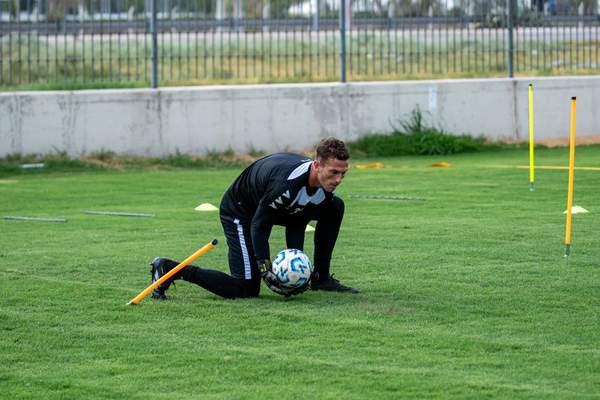
Good ball control is rarely about one flashy move. It is the ability to receive, move, protect, and redirect the ball without breaking your rhythm. The best soccer ball control drills train that rhythm from several angles: both feet, different surfaces of the foot, changes of direction, tight spaces, and movement that looks more like a real match than a stationary warm-up.
A useful way to think about ball mastery is simple: every touch should have a purpose. Some touches keep the ball close, some move it into space, and others set up the next action. Practicing those decisions alongside technique helps turn repetitive touch drills into skills you can actually use under pressure.
Build Control With Both Feet
Begin with the ball directly in front of you and alternate light inside-foot touches from right to left. Keep your knees slightly bent, stay on the balls of your feet, and make the touches small enough that the ball never escapes your immediate control.
After 30 to 45 seconds, change the pattern. Use the outside of each foot, then alternate inside and outside touches on the same foot before switching sides. These simple soccer ball mastery drills improve balance as well as touch because your body must repeatedly shift weight while the ball stays close.
Use Different Surfaces of the Foot
Practice using the inside, outside, sole, and laces area so you become comfortable manipulating the ball from different angles. Sole rolls are especially useful in tight spaces: place the sole lightly on top of the ball and roll it across your body, then receive it with the opposite foot.
Another effective pattern is a pull-push. Drag the ball backward with the sole, then push it forward or diagonally with the inside of the same foot. Start slowly enough to stay balanced. Speed matters only after the movement is clean.
Train Tight-Space Footwork
Place four cones, shoes, or small markers in a square about three to four yards across. Dribble freely inside the square for one minute without touching a marker. Use short touches and change direction every few seconds. As your control improves, shrink the area.
The smaller space punishes heavy touches and encourages sharper footwork drills. Do not stare at the ball continuously. Glance down when necessary, but regularly lift your eyes toward the room, field, or a fixed target. In a match, control is useful only if you can also see teammates, defenders, and open space.
Add a Scanning Challenge
If you train with a partner, ask them to hold up fingers while you dribble and call out the number without stopping the ball. When training alone, place three different objects around the space and look up after every three or four touches to identify one. This small change adds awareness to a basic coordination drill.
Practice Turns That Protect the Ball
Set one marker as a turning point, dribble toward it, and turn away before crossing it. Practice an inside cut, outside cut, sole drag-back, and Cruyff-style turn. Approach at a controlled speed first, then accelerate for two or three steps after the turn.
For a practical scenario, imagine receiving the ball near the touchline with a defender approaching from behind. A first touch straight forward may trap you against the line. A controlled inside touch across your body can move the ball away from pressure and open the field. Rehearsing that action around a cone makes the match situation feel familiar.
Make First Touch Part of Control Training
Pass the ball against a wall and receive it with one touch before returning it. Alternate feet and vary the receiving surface. Cushion the ball with the inside of the foot, use the outside to take it across your body, or receive with the sole when the pass arrives along the ground.
Your first touch should lead naturally into the next action. Instead of stopping the ball dead every time, angle the receiving foot so the ball moves slightly into the space where you want to pass or dribble next. That habit connects touch drills with real decision-making.
Useful related practice topics for internal linking include soccer dribbling drills, first touch training, and agility footwork drills.
Progress From Repetition to Game-Like Movement
Once a movement feels reliable, add a trigger such as a sprint, turn, pass, or change of pace. For example, perform 20 alternating inside touches, dribble five yards at speed, make a sharp turn, and return using the opposite foot as much as possible.
You can also create a 10-minute circuit: two minutes of inside-outside touches, two minutes of sole rolls and pull-pushes, two minutes of tight-square dribbling, two minutes of turns, and two minutes of wall passing. Work with control rather than rushing. Clean repetitions at moderate speed are more valuable than fast repetitions full of heavy touches.
Common Mistakes That Slow Improvement
One mistake is chasing speed too early. If the ball repeatedly gets more than a step away, reduce the pace until the movement is controlled. Another is training only the dominant foot. Give the weaker foot equal repetitions, even if it feels awkward at first.
Progress by reducing space, increasing movement speed, adding scanning, using the weaker foot, or finishing with a pass. Small changes force the body to adapt without turning every session into a completely new exercise.
Frequently Asked Questions
How often should I practice soccer ball control drills?
Short, frequent sessions work well because quality matters more than exhaustion. Ten to twenty minutes several times per week can build useful repetition, especially when you stay focused on clean touches and both-foot development.
Can beginners practice in a small space?
Yes. Many exercises need only a ball and a few square yards. Start with slow inside touches, sole rolls, and gentle direction changes before adding faster footwork or more complex turns.
How can I improve my weaker foot?
Begin each drill with the weaker foot, match the number of repetitions on both sides, and use the weaker foot for simple wall passes and receiving practice. Deliberate repetition matters more than forcing advanced moves too soon.
Should I look at the ball during control drills?
Some glances are normal, especially while learning a new movement. Over time, practice lifting your head between touches so you can control the ball while also scanning the space around you.
Turn Better Touches Into Better Decisions
Ball control improves fastest when technique and awareness develop together. Train both feet, use several foot surfaces, work in tight spaces, practice purposeful turns, and make first touch part of the routine. Then add scanning and short bursts of movement so the drills begin to resemble situations you face in a match.
The goal is not to collect complicated moves. It is to make simple touches reliable enough that you can receive the ball, protect it, change direction, and play your next action without hesitation. That kind of control gives you more time, more options, and greater confidence whenever the ball reaches your feet.