

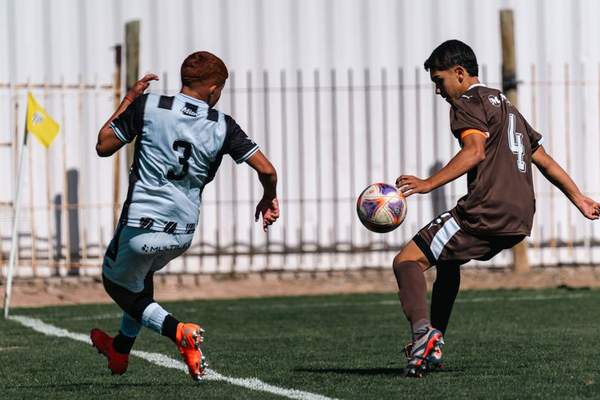
The 3-4-3 soccer formation is often described as an attacking gamble: three defenders behind an ambitious front line. That description misses its most interesting feature. The shape can stretch an opponent across the entire field, then use those same wide positions to trap the ball when possession changes. Its success depends less on the numbers on a tactics board than on the timing between wingbacks, forwards, midfielders, and center backs.
How the 3-4-3 Is Arranged
A typical 3-4-3 has three center backs, two central midfielders, two wingbacks, and three forwards. The wingbacks sit outside the midfield pair and provide most of the width, while the front three can be arranged as a striker with two wide forwards or a striker supported by two narrower attacking midfielders. The latter variation is commonly called a 3-4-2-1.
The shape changes with the ball. In possession, advanced wingbacks can help create a five-player attacking line. Without it, they retreat alongside the center backs to form a back five. That flexibility is the foundation of 3-4-3 tactics, but it also requires players to recognize when to advance and when to hold their positions.
Why Width Creates More Than Crossing Opportunities
Stretch the Back Line, Then Attack the Gap
Imagine the left wingback receiving near the touchline while the left forward moves into the inside channel. A defending fullback now faces a choice: move toward the wingback and leave room inside, or stay narrow and allow the wingback time to carry the ball. The striker occupies a center back, making that decision harder.
This is how a wide overload becomes a central chance. If the opponent sends a midfielder across to help, space may open beside their central midfielders. A quick pass inside can release the forward between the lines; a return pass outside can set up a low cross or cutback. The aim is not to cross constantly. It is to force defenders into choices they dislike.
The Front Three Shape Determines the Overloads
With two wide forwards, the wingback may overlap outside the winger or underlap through the inside channel. Those movements should be coordinated: two players making the same run can make defending easier. With two narrow attacking midfielders, the wingbacks usually hold the touchlines while the inside players find gaps between the opposition’s fullbacks and center backs.
Both versions can occupy five attacking lanes: left wing, left inside channel, center, right inside channel, and right wing. Occupying those lanes is a useful guide, not a rule requiring everyone to stand still. Rotations matter as long as another teammate fills the space that has been vacated. A comparison with the 4-3-3 formation also shows why the role of the wide defenders, rather than the formation label alone, determines attacking width.
How Coordinated Pressing Works
Guide the Ball Toward the Touchline
A 3-4-3 can press with three forwards across an opponent’s first line. The striker angles a run to discourage a pass into central midfield or across the back line. The ball-side forward closes the receiving defender, while the opposite forward tucks in to limit an easy switch. The goal is to make the next pass predictable.
Once the ball reaches the opposition fullback, wingback pressing becomes important. The near wingback can jump toward that receiver, the near central midfielder blocks the inside passing lane, and the wide forward pressures from another angle. The touchline removes one escape route, turning several individual runs into a coordinated trap.
Pressing Requires Cover Behind the Jump
The outside center back must be ready to cover the channel behind an advanced wingback. Meanwhile, the central center back organizes the remaining defenders, and the far wingback narrows his position. If the wingback presses without this support, one pass down the line can expose a large space. Triggers such as a poor first touch or a slow square pass make it safer to jump. If the press is beaten, the team can retreat into a 5-2-3, or a 5-4-1 when the wide forwards recover deeper.
A Match Scenario: Breaking a 4-4-2
Suppose an opponent defends in a compact 4-4-2. Your three center backs initially have a numerical advantage against the two strikers, which can help one outside center back carry the ball forward. As the right wingback moves high and wide, the right forward drifts inside, drawing the opposition left back toward the half-space.
If the opposing left midfielder follows your wingback, your right central midfielder may have room to receive. If that midfielder stays narrow, the wingback can receive in space. If the left back rushes out, the inside forward can run behind. The advantage comes from reading the defender’s response rather than forcing one rehearsed pass.
Should the move break down near that touchline, the same three nearby players can counter-press immediately, provided the center backs and remaining midfielders have maintained defensive cover. Width and pressing are linked because good attacking distances also create nearby defenders after a turnover.
Where the Formation Can Be Exposed
The main vulnerability is the space outside the back three. An opponent that switches play quickly after drawing one wingback forward can attack the far side before the shape resets. Another problem appears centrally: two midfielders may be outnumbered by a team using three central midfielders, especially when the narrow forwards do not help. The team may need to stagger its wingbacks or ask a forward to drop into midfield.
A Practical Training Exercise
Set up a half-field game with one team arranged in a 3-4-3 against opponents building through a back four and midfield. Mark a wide zone on each side. Award a bonus point when an attacking move uses a wingback and inside forward in combination, and another when a press forces a turnover in a wide zone soon after the ball arrives there.
Frequently Asked Questions
Is the 3-4-3 soccer formation attacking or defensive?
It can be both. Wingbacks pushing high create attacking width, while their recovery produces a back five. The team’s pressing height and the roles of its forwards determine how aggressive it feels.
What is the difference between 3-4-3 and 3-4-2-1?
The 3-4-2-1 is a common version of the 3-4-3 in which two narrow attacking midfielders play behind one striker. A wider 3-4-3 keeps the forwards closer to the flanks.
Why do wingbacks need so much stamina?
They may need to support attacks high on the field, press opposing fullbacks, and recover into a five-player defensive line. Positioning and timing reduce unnecessary runs, but the physical demands remain considerable.
Can a 3-4-3 struggle against three central midfielders?
Yes. Its central pair can be outnumbered unless a forward drops closer, a defender steps forward, or the team controls central passing lanes through compact positioning.
Making Width and Pressure Work Together
The 3-4-3 is strongest when its players treat attack and defense as one connected problem. Wingbacks stretch the field, inside forwards exploit the resulting gaps, and coordinated pressing tries to win the ball back before opponents can attack the space behind. The formation creates the opportunities; collective movement makes them count.