

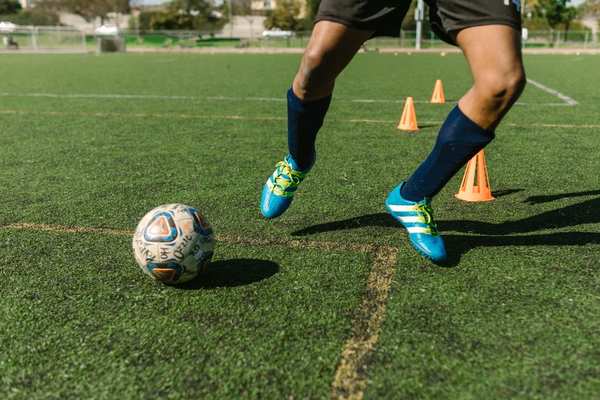
A defender takes one heavy touch, and the winger suddenly has a chance to steal the ball. The difference between winning that race and arriving late may be the first three steps, not top sprinting speed. Soccer speed and agility drills prepare players for these moments: accelerating into space, slowing down under control, changing direction, and reacting to opponents.
The best sessions are not endless cone patterns performed until everyone is exhausted. They combine sharp, short efforts with good technique, enough recovery, and decisions that resemble real play.
Train the Movements That Decide Close Contests
Acceleration means building speed quickly. Deceleration means reducing it without losing balance. Change of direction is a planned cut or turn; agility adds a response to an unpredictable cue. Players need all four when closing down a striker, recovering after a missed tackle, or running behind a defense.
Start with simple movements, then introduce angles, opponents, and the ball. Fast feet alone do not guarantee effective match movement if a player cannot brake or recognize when to move.
Warm Up Before Fast, Sharp Movements
Allow roughly 10–15 minutes for an active warm-up. Begin with light jogging, lateral movement, skipping, and controlled mobility. Progress to gradual accelerations, small hops with stable landings, and easy direction changes before maximal sprinting.
A structured soccer warm-up such as FIFA 11+ emphasizes strength, balance, and movement control. Research has found injury-prevention benefits when teams perform it consistently, although no warm-up eliminates injury risk. On slippery ground, reduce cutting speed until traction is reliable.
Soccer Speed and Agility Drills to Try
Short Starts Over 5–10 Meters
Mark a start and finish line five to ten meters apart. Begin in an athletic stance, lean slightly forward, and push the ground behind you for the first strides. Sprint through the finish rather than reaching with an overlong step. Complete four to six repetitions, resting around 45–90 seconds between quality efforts.
Vary your starting position: facing forward, turned sideways, or moving slowly before the signal. These acceleration drills simulate chasing a loose ball or escaping a marker.
Sprint, Brake, and Hold
Set cones eight meters apart, with a clear stopping zone beyond the second cone. Accelerate toward it, lower your center of mass, and take several controlled steps to stop within the zone. Hold a balanced position for two seconds. Repeat three to five times.
Effective braking is an overlooked part of soccer agility exercises. Avoid leaning backward or stopping with one stiff-legged plant. Once the movement looks smooth, gradually shorten the stopping zone instead of immediately sprinting faster.
Five-Meter Out-and-Back Turn
Put two cones five meters apart. Sprint to the far cone, slow with short steps, turn, and accelerate back. Alternate turning directions for three or four repetitions, with ample rest.
These change of direction drills teach players to prepare for a turn before reaching the cone. Instead of a last-second lunge, approach under control, plant firmly, and drive toward the new target. Stop if a knee or ankle feels painful.
Coach-Called Y Cut
Set a starting cone and two finish gates forming a Y, each about five meters beyond a central cone. Sprint toward the middle. As you approach, a coach calls left or right; brake just enough to cut through the chosen gate. Start with an early call, then delay it as control improves.
Unlike memorized cone routes, reaction drills require players to process information while moving. The aim is a quick, balanced response, not guessing the direction early. Recover fully between attempts.
Mirror the Attacker
Mark a rectangle about four meters wide. One player leads with short lateral and diagonal movements; a partner mirrors while maintaining a safe distance. Work for five to eight seconds, then swap roles. Use four rounds each with rest.
Watch the attacker’s movement rather than staring at your feet. Defenders should move efficiently without crossing their legs wildly to copy every fake. This turns footwork into the skill of reading an opponent.
Loose-Ball Decision Race
Stand two players several meters from a coach holding a ball. The coach rolls it into one of two open channels. Players react, sprint, and compete to reach it first; the winner takes a controlled touch into a marked gate. Change the release angle each time and avoid unsafe contact.
This connects physical speed to a soccer decision: read the ball, choose a running line, arrive balanced, and play the next action. It bridges isolated speed work and small-sided games.
Build a Short Session Without Sacrificing Speed
For a practical 20-minute main block after warming up, use short starts for four repetitions, sprint-and-brake work for four, Y cuts for four, and three rounds of the mirror exercise. Include recovery in that time. If a player’s speed drops or foot placement becomes sloppy, extend the rest or reduce repetitions.
For many recreational players, one or two focused sessions per week is a manageable starting point, adjusted to match load, age, fitness, and recovery. Place the fastest efforts early in practice, before intense conditioning. On busy match weeks, reduce volume rather than adding more demanding sprinting.
Developing sprint mechanics alongside soccer conditioning exercises can help organize fitness work. Soccer defensive positioning gives movement a tactical purpose, while first-touch soccer drills offer a useful next step toward ball-based practice.
Common Mistakes That Limit Progress
Training every repetition at maximum effort while fatigued often turns speed practice into endurance work. Rushing into tight cuts before learning to slow down is another mistake. Players also lose valuable training time when they stare at the ground through elaborate ladder routines instead of watching a cue or opponent.
Track something simple, such as your consistency over ten meters or how comfortably you stop within a marked zone. Improve execution before adding distance, sharper angles, or harder decisions. Younger players and those returning from injury need appropriately scaled drills and professional guidance where necessary.
Frequently Asked Questions
How often should soccer players practice speed and agility?
One or two focused sessions weekly is a reasonable starting point for many recreational players. Coordinate them with matches and team practices, and allow recovery between demanding sessions.
Do agility ladders make soccer players faster?
Ladders can provide rhythm and coordination challenges, but they cannot replace acceleration, controlled stopping, and reactive movement against realistic cues.
Should players use a ball in every drill?
No. Ball-free repetitions make it easier to learn efficient movement. Add the ball later so the player must transfer that quality into a soccer action.
What matters more: straight-line speed or quick turns?
Both matter. A forward running behind a defense needs acceleration; a defender responding to a feint needs braking, turning, and recognition. Train the demands of your position.
Make Every Step Serve the Game
Better match movement begins with clean first steps, reliable braking, balanced cuts, and fast responses to changing information. Keep drills short and purposeful, progress gradually, and connect them to realistic scenarios. The goal is not winning a cone drill; it is arriving at the right place, under control, in time to make the next play.