

The Role of Agility in Modern Soccer
There’s a moment in every match when the game tightens—space shrinks, defenders close in, and decisions must happen instantly. That’s where agility training for soccer becomes more than just another workout; it becomes a defining skill. Agility is the ability to change direction quickly, maintain balance, and react with precision. It’s not just speed. It’s controlled speed, guided by awareness.
Watch a skilled midfielder glide past opponents or a defender pivot sharply to block a run, and you’ll notice something subtle: their bodies move efficiently, without hesitation. That smoothness doesn’t happen by accident. It’s trained, refined, and repeated until it becomes instinct.
Understanding What Agility Really Means
Agility often gets lumped together with speed, but they’re not quite the same. Sprinting in a straight line is one thing; adjusting your body mid-run, stopping, turning, and accelerating again is something else entirely.
Agility in soccer blends three elements. There’s physical control, which keeps your body stable during quick shifts. There’s coordination, which ensures your feet and mind stay in sync. And then there’s reaction time, the ability to respond instantly to what’s happening around you.
When these elements come together, movement becomes efficient rather than frantic. That’s the difference between chasing the ball and controlling the moment.
Why Agility Training for Soccer Matters at Every Level
Whether you’re playing casually or competing at a high level, agility influences nearly every action on the field. It shows up when a winger cuts inside, when a striker dodges a tackle, or when a goalkeeper shifts position in a split second.
For younger players, agility training builds a foundation. It teaches body awareness and movement patterns that will carry into advanced skills later on. For experienced players, it sharpens reactions and reduces wasted movement, helping conserve energy during intense matches.
There’s also an often overlooked benefit: injury prevention. Strong, controlled movements reduce strain on joints and muscles, especially during sudden stops or awkward landings.
Building the Foundation Before Advanced Drills
Before diving into complex exercises, it’s worth paying attention to the basics. Agility isn’t just about moving faster—it’s about moving correctly.
Posture plays a huge role. A slightly lowered center of gravity allows for quicker changes in direction. Balance is equally important; without it, even the fastest player can stumble under pressure.
Foot placement matters too. Light, quick steps are more effective than heavy, delayed movements. When your feet respond quickly, your entire body follows.
These small adjustments might seem simple, but they form the backbone of effective agility training for soccer.
Ladder Drills and the Art of Quick Feet
Agility ladders are a familiar sight on training grounds, and for good reason. They encourage quick, precise footwork while reinforcing rhythm and coordination.
What makes ladder drills effective is their simplicity. You’re not focusing on speed alone—you’re focusing on control. Each step needs to land cleanly, with your body staying balanced and aligned.
Over time, these drills teach your feet to react faster than your conscious mind. That automatic response becomes invaluable during a match, where there’s no time to think through every movement.
Cone Drills That Mirror Game Situations
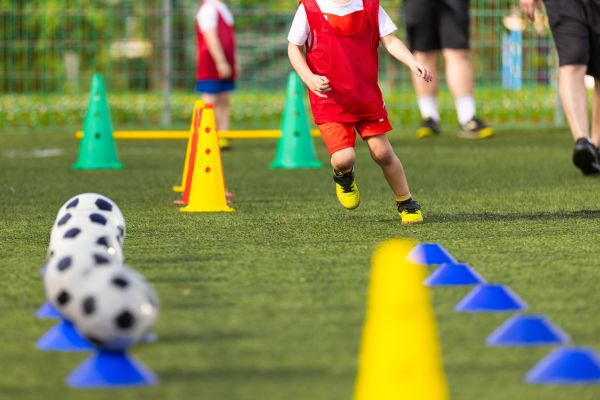
Cones introduce direction changes, which is where agility truly comes to life. Unlike ladder drills, cone exercises simulate real movements you’d use in a game—cutting, turning, and accelerating in different directions.
The key is variety. Straight lines don’t exist in soccer for long. Players move diagonally, pivot sharply, and adjust constantly based on the ball and opponents.
Cone drills help bridge the gap between training and gameplay. They encourage players to move with purpose rather than just speed, replicating the unpredictability of a live match.
Reaction-Based Training for Real Match Intensity
One of the most overlooked aspects of agility training for soccer is reaction. In a real match, players don’t move in pre-planned patterns. They react—often in a fraction of a second.
Reaction drills introduce unpredictability. A coach might signal a direction, a teammate might pass unexpectedly, or a visual cue might dictate movement. These exercises train both the mind and body to respond together.
It’s this connection between thinking and moving that separates average agility from elite performance. When reactions become instinctive, players gain a noticeable edge.
Strength and Stability as Hidden Components of Agility
Agility isn’t just about speed and coordination. Strength, particularly in the core and lower body, plays a quiet but critical role.
Strong muscles provide stability during rapid movements. They allow players to stop quickly without losing balance and to push off powerfully in new directions.
Exercises that focus on balance—like single-leg movements or controlled lunges—build this stability. Over time, they make quick movements feel more controlled and less risky.
Without this foundation, agility can become inconsistent. With it, movement becomes smoother and more reliable.
The Importance of Consistency Over Complexity
It’s tempting to chase complicated drills, especially when training videos make them look impressive. But agility doesn’t improve overnight, and it doesn’t require endless variation.
Consistency matters more than complexity. Repeating well-designed drills helps build muscle memory, which is essential for quick reactions during a match.
Even a short session, done regularly, can lead to noticeable improvement. Over time, these small gains add up, shaping how a player moves on the field.
Listening to Your Body During Training
There’s a fine line between pushing limits and overtraining. Agility drills can be demanding, especially when they involve rapid direction changes and high intensity.
Fatigue affects coordination. When you’re tired, movements become less precise, increasing the risk of mistakes or injury. Paying attention to how your body feels isn’t a sign of weakness—it’s part of effective training.
Rest and recovery play a role here. Muscles need time to adapt, and the nervous system needs time to reset. Ignoring that can slow progress rather than speed it up.
Bringing Agility Into Real Match Performance
Training is only half the story. The real goal is to carry those movements into a match.
Agility shows up in small moments—a quick turn to escape pressure, a sudden sprint to intercept a pass, or a subtle shift that creates space. These moments often decide the flow of the game.
The more natural your movements become in training, the more effortlessly they appear during competition. It’s not about thinking faster; it’s about moving without hesitation.
A Natural Conclusion on Agility Training for Soccer
Agility training for soccer isn’t about flashy drills or complicated routines. It’s about refining the way your body moves—making each step more controlled, each turn more efficient, and each reaction more instinctive.
Over time, these improvements change how you experience the game. Movements feel lighter, decisions feel quicker, and the field seems just a little more open.
And maybe that’s the real value of agility. It doesn’t just make you faster. It makes the game feel slower, clearer, and more within your control.